Fat Augmentation in Ludhiana: Everything You Should Know Before Choosing Fat Augmentation.
Not everyone wants a cosmetic procedure that involves an artificial implant. For some people, using their own body fat to add volume to a specific area can be an appealing alternative.
This is where fat augmentation comes in.
Fat augmentation, also known as fat grafting or fat transfer, involves removing fat from one part of the body, processing it and carefully transferring it to another area where additional volume or contouring is desired.
If you are searching for fat augmentation in Ludhiana, it is important to understand that this is not simply a matter of “removing fat and putting it somewhere else.” It is a surgical procedure that requires careful patient selection, planning, appropriate fat harvesting and precise placement.
The results can be subtle and natural-looking when the procedure is appropriately planned for the individual patient.
What Is Fat Augmentation?
Fat augmentation is a cosmetic surgical procedure that uses a person’s own fat tissue to increase volume or improve contours in another area of the body.
The basic process involves three stages:
Fat is harvested from a suitable donor area.
The harvested fat is processed and prepared.
The purified fat is transferred into the target area.
Because the tissue comes from the patient’s own body, fat grafting can provide a natural-tissue approach to adding volume.
However, not all transferred fat necessarily survives permanently. Some of the transplanted fat can be naturally reabsorbed by the body, which is why your surgeon may discuss expected volume changes and the possibility of additional treatment depending on your goals.
Where Can Fat Augmentation Be Used?
The term “fat augmentation” can refer to different procedures depending on the area being treated.
Fat transfer may be considered for areas such as:
Face and cheeks
Lips and selected facial areas
Breasts in carefully selected patients
Buttocks and body contouring
Certain areas with contour irregularities
Areas requiring soft-tissue volume restoration
The appropriate use of fat grafting depends on the patient’s anatomy, available donor fat, desired outcome and overall health.
During a consultation, your surgeon should assess whether fat transfer is actually suitable for the area you want to enhance.
Why Choose Your Own Fat for Augmentation?
One of the major attractions of fat transfer is that it uses tissue from your own body.
For suitable patients, this can offer several advantages.
Natural-looking volume
Fat can be strategically placed to create gradual contours rather than a single, uniform volume increase.
Dual benefit
Fat is harvested from another area of the body. Depending on your anatomy, this can allow some contouring of the donor area while adding volume elsewhere.
Your own tissue
Since the transferred material is your own fat, there is no separate synthetic implant involved in the fat itself.
Customised treatment
The amount and placement of fat can be planned around your anatomy and aesthetic goals.
However, “natural” does not automatically mean risk-free. Fat augmentation remains a medical procedure and should be performed by an appropriately qualified and experienced surgeon.
How Does Fat Augmentation Work?
The exact technique varies according to the area being treated, but the procedure generally involves several steps.
Step 1: Consultation and assessment
Your surgeon first evaluates your concerns, medical history, body proportions, available donor fat and expectations.
This is an important stage because not everyone has enough suitable fat for the desired augmentation.
Step 2: Selecting the donor area
Fat may be harvested from areas where there is adequate tissue, depending on your individual anatomy.
Common donor areas can include the abdomen, thighs, flanks or other suitable regions.
Step 3: Fat harvesting
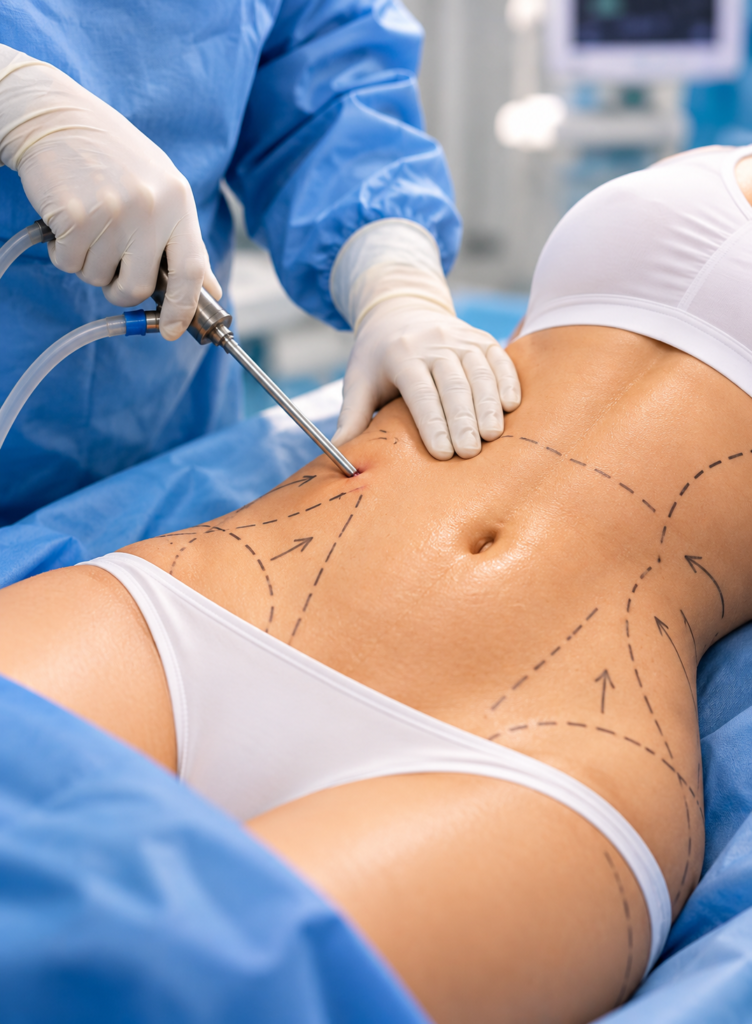
Fat is removed using a liposuction-based technique designed to collect fat cells while minimising unnecessary trauma to the tissue.
Step 4: Fat preparation
The harvested material is processed so that the usable fat can be separated and prepared for transfer.
Step 5: Fat placement
The prepared fat is carefully introduced into the target area using small-volume deposits and appropriate surgical techniques.
The goal is not simply to add as much volume as possible. Placement, symmetry, contour and tissue characteristics all matter.
Who Is a Good Candidate for Fat Augmentation?
Fat augmentation may be suitable for adults who:
Want additional volume or contour improvement
Have sufficient donor fat
Are in reasonably good overall health
Have realistic expectations
Understand that some transferred fat may be reabsorbed
Are willing to follow post-operative instructions
The ideal candidate is not determined by weight alone.
Someone who is very lean may not have enough donor fat for the desired result, while someone with adequate donor areas may be able to achieve a meaningful improvement.
A personal consultation is necessary to determine suitability.
Fat Augmentation vs Implants: Which Is Better?
This is one of the most common questions patients ask.
There is no universal answer.
Fat augmentation and implants are different approaches with different considerations.
With fat transfer, the patient’s own fat is used to create additional volume. With an implant-based procedure, a manufactured implant provides the volume.
Your surgeon may recommend one approach, another, or in selected situations a combination, depending on your anatomy and goals.
Factors such as available donor fat, desired volume, skin quality, existing tissue and the area being treated can influence the recommendation.
The most appropriate procedure is the one that matches your individual anatomy and expectations—not necessarily the procedure that is trending online.
How Much Fat Is Needed?
There is no standard amount of fat required for every patient.
The amount depends on:
Treatment area
Desired volume
Existing tissue
Body proportions
Donor-site availability
Skin and tissue characteristics
Whether the procedure is being performed for augmentation, contour correction or reconstruction
A surgeon should determine the amount during your assessment rather than promising a fixed result before examining you.
What Happens to the Transferred Fat?
This is an important point to understand before choosing fat augmentation.
Not every fat cell transferred during the procedure will survive permanently.
A proportion of the transferred fat may be absorbed by the body during the healing process. The final result therefore cannot always be predicted simply by looking at the amount of fat initially transferred.
The result develops gradually as swelling settles and the transferred tissue stabilises.
In some situations, a second procedure may be considered if additional volume is desired or if significant volume has been lost during healing.
What Is Recovery Like After Fat Augmentation?
Recovery depends largely on the treatment area and the amount of surgery involved.
It is normal to experience some degree of swelling, bruising, tenderness or tightness during the early recovery period.
Your surgeon may advise you to:
Follow wound-care instructions carefully
Take prescribed medicines as directed
Avoid strenuous activities for the recommended period
Protect the treated and donor areas
Attend scheduled follow-up appointments
Avoid pressure on specific areas when instructed
Returning to normal activities too quickly can interfere with recovery, so post-operative instructions should be followed carefully.
Your surgeon will give you a personalised recovery timeline based on the procedure performed.
Is Fat Augmentation Safe?
Like any surgical procedure, fat augmentation has potential risks.
These can include infection, bleeding, swelling, contour irregularities, asymmetry, changes in sensation, fat reabsorption and complications related to the surgical or anaesthetic process.
The specific risks depend on the treatment area and technique.
Some forms of fat transfer, particularly larger-volume transfers to certain body areas, have specific safety considerations. For this reason, the procedure should be performed by a properly qualified surgeon in an appropriate medical setting with established safety protocols.
A consultation should include a discussion of both benefits and potential complications.
What About Fat Augmentation Cost in Ludhiana?
The cost of fat augmentation in Ludhiana can vary significantly from one patient to another.
There is no meaningful “one-size-fits-all” price because the total cost can depend on:
Treatment area
Amount of fat required
Liposuction requirements
Surgical complexity
Anaesthesia
Hospital or facility charges
Surgeon’s professional fees
Post-operative care
Whether additional procedures are required
If you are comparing prices, make sure you are comparing similar procedures and asking what is included in the quoted amount.
A very low advertised price may not represent the complete cost of treatment.
Instead of asking only, “What is the price?”, ask:
“What does my complete treatment plan include?”
That gives you a much clearer picture.
How to Choose a Fat Augmentation Surgeon in Ludhiana
Choosing the surgeon is arguably one of the most important decisions you will make.
When researching fat augmentation in Ludhiana, consider the following:
Check the surgeon’s qualifications
Make sure the doctor is appropriately qualified and trained for the procedure you are considering.
Discuss your expectations
A good consultation should involve a two-way conversation. Explain what you want to improve, but also listen to what the surgeon believes is realistically achievable.
Ask about the technique
Understand how the fat will be harvested, prepared and transferred.
Ask about safety
Don’t hesitate to ask about the facility, anaesthesia, monitoring and emergency protocols.
Review appropriate results
If before-and-after photographs are shown, ask whether they represent cases similar to yours and whether you have permission to view them.
Understand aftercare
Ask who will be available if you have questions or concerns after surgery.
Don’t choose only on price
The cheapest option is not necessarily the safest or most suitable option.
Questions to Ask During Your Consultation
Before scheduling fat augmentation, consider asking your surgeon:
Am I a suitable candidate for fat transfer?
Where will the donor fat be taken from?
How much fat can realistically be transferred?
How much volume should I expect to retain?
Which technique do you recommend for me?
What are the potential risks?
What type of anaesthesia will be used?
How long will recovery take?
When can I return to work and exercise?
Could I need another procedure in the future?
What is included in the total treatment cost?
A good consultation should leave you informed—not pressured.
Is Fat Augmentation Permanent?
The answer is more nuanced than simply saying “yes” or “no.”
Fat cells that successfully establish a blood supply in their new location can provide long-lasting volume. However, the body can reabsorb a portion of the transferred fat, particularly during the early healing phase.
Changes in body weight and the natural ageing process can also affect the appearance of the treated area over time.
This is why surgeons generally discuss fat augmentation as a long-term contouring procedure rather than promising a completely unchanged result for life.
Why Consultation Matters Before Fat Augmentation
Online photographs and social media can make cosmetic procedures look straightforward.
In reality, every body is different.
Two people may want the same procedure but require completely different treatment plans because their anatomy, skin quality, fat distribution and expectations are different.
A professional assessment allows the surgeon to determine:
Whether fat transfer is appropriate
Which donor area may be suitable
How much volume is realistic
What technique should be considered
What risks apply to your individual case
What kind of result you can reasonably expect
That conversation should happen before you make a booking.
Final Thoughts on Fat Augmentation in Ludhiana
Fat augmentation can be an effective option for selected patients who want to enhance volume or improve body contours using their own fat.
But the best result doesn’t begin in the operating room. It begins with proper patient selection, realistic expectations, thoughtful surgical planning and an experienced medical team.
If you are considering fat augmentation in Ludhiana, don’t rush into treatment because of an advertisement, discount or social-media trend.
Start with a consultation. Understand your options, ask questions and make an informed decision based on your individual anatomy and goals.
Your treatment should be planned for you—not copied from someone else’s result.
Frequently Asked Questions
What is fat augmentation?
Fat augmentation is a cosmetic procedure in which fat is harvested from one part of the body and transferred to another area to add volume or improve contours.
Is fat augmentation the same as fat transfer?
The terms are often used interchangeably. Fat grafting and fat transfer generally refer to the process of moving a person’s own fat from one area to another.
How much does fat augmentation cost in Ludhiana?
There is no fixed cost. Pricing depends on the treatment area, amount of fat required, liposuction needs, surgical complexity, anaesthesia, facility and post-operative care.
Does transferred fat last permanently?
Fat cells that successfully survive the transfer can provide long-lasting volume. However, some of the transferred fat is normally reabsorbed, particularly during the early healing period.
Can fat augmentation be combined with liposuction?
Yes, fat harvesting itself involves a liposuction technique. In selected patients, the procedure can provide both contouring at the donor site and volume enhancement at the recipient site.
Is fat augmentation suitable for everyone?
No. Suitability depends on your health, anatomy, available donor fat, treatment goals and the area being treated. A consultation with a qualified surgeon is essential.
How long does recovery take?
Recovery varies according to the treatment area and extent of surgery. Your surgeon will provide specific instructions about activity, wound care, compression garments and returning to normal routines.
Should I choose fat augmentation or an implant?
Neither is automatically better. The appropriate option depends on your anatomy, goals, available donor fat and the area being treated. Your surgeon can explain which approach is more suitable for you.